
We may earn a small commission if you click links and make a purchase. This article is for informational purposes only and does not constitute financial advice.
Last Updated on February 6, 2026
If you could travel back in time exactly one year, to February 2025, and show a Wall Street trader the 12-month silver chart we are looking at today, they would have laughed you out of the room.
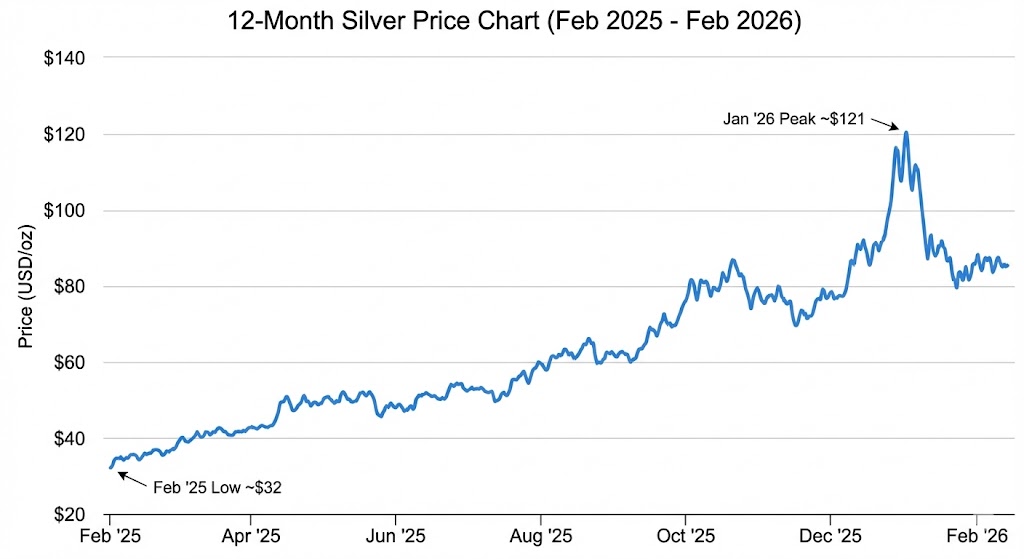
Back then, silver was a “dead” asset. It was boring. It was frustrating. It was trading near $32 per ounce, a respectable level but hardly life-changing. Today, as we stare at a chart that recently printed an all-time high of $121.50, the laughter has been replaced by awe—and for many who missed the boat, regret.
The last 12 months (February 2025 – February 2026) will be studied by market historians for decades. This specific chart is a textbook example of a “Super-Spike”: a rare market phenomenon where structural scarcity collides with monetary panic to create a vertical repricing event.
-
The Low: ~$32.00 (February 2025)
-
The High: $121.50 (January 24, 2026)
-
The Gain: ~280% peak-to-trough in under a year.
But a chart is more than just a line on a screen; it is a map of human psychology. It tells the story of fear, greed, denial, and capitulation. To understand where silver is going next (now that we have corrected to the mid-$80s), we must first dissect the anatomy of the move.
This article breaks down the 12-month chart into four distinct chapters, revealing how we got here and what the tea leaves say about the future.
1-Year Silver Price Chart
Q1 2025: The “Stealth Phase” ($32 – $38)
Every great bull market begins in obscurity. The first quarter of 2025 was the “Stealth Phase,” a period characterized not by explosive gains, but by a grinding, maddening consolidation that lulled retail investors to sleep.
The Landscape of Boredom
In early 2025, the investment world was obsessed with two things: The “AI 2.0” stock rally and the stabilization of the bond market. Commodities were an afterthought.
-
The Price Action: For three months, silver ping-ponged between $32 and $35. Every time it looked ready to break out, it was sold off.
-
The Sentiment: Retail forums were dead. The “Silver Squeeze” movement of 2021 was a distant memory. Capitulation was high—long-time holders were selling their stacks to buy NVIDIA and Microsoft.
The “Smart Money” Signal
However, looking back at the chart now, the signs of accumulation were obvious to those who knew where to look. While the price was flat, the On-Balance Volume (OBV) was rising. This divergence meant that while retail investors were selling, large institutional entities (likely sovereign wealth funds and industrial refiners) were quietly scooping up every available ounce without moving the price.
The Golden Cross
The technical “lighting of the fuse” occurred in March 2025.
-
The Event: The chart printed a “Golden Cross”, where the 50-day moving average crossed above the 200-day moving average on high volume.
-
The Reaction: To the general public, this meant nothing. But to algorithmic trading bots and technical funds, it was a “Buy” signal. This technical trigger set the stage for the liquidity that would flood the market in Q2.
Retrospective Lesson: The most profitable time to buy is always when an asset is technically strong (rising moving averages) but culturally ignored. Q1 2025 was the textbook definition of “investing in quiet times.”

Q2 2025: The “Industrial Awakening” ($38 – $50)
If Q1 was about boredom, Q2 was about realization. The spring of 2025 marked the moment the market woke up to the mathematical impossibility of the supply chain.
The Catalyst: The “Impossible” Report
In April 2025, the Silver Institute released its annual World Silver Survey. While the market expected a deficit, the numbers were shocking. The report confirmed that industrial demand had stripped the market of nearly 200 million ounces in the previous year, leaving vault stocks at critical lows.
Suddenly, the narrative shifted from “speculation” to “scarcity.”
-
The Reaction: Large industrial users—solar panel manufacturers in China and electronics firms in Korea—stopped waiting for lower prices. They realized that the COMEX spot price was irrelevant if they couldn’t secure physical delivery.
-
Direct Buying: Reports surfaced of major tech conglomerates bypassing the exchanges entirely to sign long-term offtake agreements directly with miners. This removed supply from the public market, tightening the noose on short sellers.
The $50 Event: Smashing the Ceiling
The most significant technical event of the decade occurred in May 2025. For 45 years, $50 per ounce had been the “Graveyard of Bulls.” It was the nominal high reached by the Hunt Brothers in 1980 and re-tested in 2011. Both times, the price collapsed immediately after touching it.
But on May 14, 2025, silver didn’t just touch $50; it sliced through it like a hot knife through butter. There was no resistance. No sell wall. The price closed the week at $54.20, signaling to the world that the “multi-decade consolidation” was over. The ceiling had become the floor.
Q3 2025: The Momentum Trend ($50 – $80)
Once the $50 barrier fell, the character of the market changed. We moved from a “Value Trade” (buying because it’s cheap) to a “Momentum Trade” (buying because it’s going up).
Institutional FOMO
The summer of 2025 was defined by the entry of the Trend Followers.
-
CTAs and Algos: Commodity Trading Advisors (CTAs) and algorithmic funds, which control trillions of dollars, are programmed to chase trends. When silver held above $50 for consecutive weeks, their models flashed “Strong Buy.”
-
The Liquidity Flood: Billions of dollars in managed futures capital flooded into the silver market. This pushed the price from $50 to $65 in a steady, disciplined 45-degree angle up-trend. This wasn’t a mania yet; it was a repricing.
The “BRICS Effect” & Decoupling
Perhaps the most bullish signal of Q3 was the decoupling from the Dollar. Historically, a strong U.S. Dollar (DXY) meant weak silver prices. But in August 2025, as the BRICS+ nations met to discuss their non-dollar trade settlement mechanisms, rumors swirled about silver being included in a new hard-asset currency basket.
-
The Anomaly: In August and September, the DXY actually rose slightly, yet silver surged from $65 to $80.
-
The Meaning: The market stopped treating silver as a dollar-derivative and started treating it as a sovereign reserve asset. This “sovereign bid” provided a relentless bid underneath the market, ensuring that every dip was bought aggressively within hours.
By the time Q3 closed, silver was sitting comfortably at $78-$80, having doubled from its Q1 lows. The “stealth” phase was long gone; the stage was set for the mania that was about to unfold.
Here is Part 3 of the article (Sections V, VI, VII, and Conclusion), completing the 12-month analysis.
Q4 2025 & Jan 2026: The “Blow-Off Top” ($80 – $121.50)
As the calendar turned to Q4 2025, the disciplined trend of the summer dissolved into something far more volatile: Mania.
This phase, often called a “Blow-Off Top,” is characterized by vertical price action, extreme media coverage, and the arrival of the unsophisticated retail speculator.
The Social Media Feedback Loop
By November and December, silver had gone viral. #SilverSqueeze3.0 was trending on social platforms. The “Fear of Missing Out” (FOMO) drove thousands of new accounts to open positions on leverage.
-
The Acceleration: It took six months for silver to go from $32 to $64. It took just six weeks for it to go from $80 to $100.
-
The Warning Signs: Experienced traders began to see cracks in the foundation. The Relative Strength Index (RSI) on the weekly chart hit 90—a level of “overbought” rarely seen in financial history. The price was rising, but volume on the up-days was starting to thin out, a classic bearish divergence suggesting the buyers were exhausted.
The Peak: January 24, 2026
The fever broke in late January. On January 24th, silver opened the Asian session with a gap up, racing to an intraday high of $121.50. It was a moment of euphoria. But by the time the New York session closed, the price had faded back to $115, leaving a long “wick” on the daily candle. In technical analysis, this is known as a “Shooting Star”—a reversal pattern that often marks the exact top of a frenzy.
Feb 2026: The “Flash Crash” & Current Support
Gravity is undefeated. As we entered February, the CME Group raised margin requirements, and the over-leveraged longs were forced to liquidate.
The Anatomy of the Drop
In the first week of February, the bottom fell out.
-
The Flush: Silver plummeted from ~$115 to a low of $71.00 in roughly 72 hours. A 30%+ correction that wiped out months of gains for latecomers.
-
The Bounce: Crucially, the buyers stepped back in. As the price tagged $71, it hit a pocket of massive institutional limit orders. This was the “smart money” that had sold at $110 rebuying their positions at a 35% discount.
The Bull Flag: A Pause, Not a Stop
Today, as we sit near $85, the technical damage looks severe but not fatal. When you zoom out to the 12-month view, the current chart pattern resembles a massive “Bull Flag”. The pole is the rise from $50 to $121, and the current chopping action between $70 and $90 is the flag.
-
The Support: The price has successfully defended the 50-day moving average, which is currently trending up around $75. As long as this level holds, the long-term uptrend remains intact.
Conclusion: Reading the Tea Leaves
The 12-month chart of silver is a masterclass in market psychology. We have witnessed the full cycle: the disbelief of Q1, the realization of Q2, the greed of Q4, and the fear of February.
So, what does the chart tell us about the next 12 months?
It tells us that the “easy money” has been made, but the “big money” is likely still ahead. Markets rarely move in a straight line. After a 200% move, a 30% correction is not just normal; it is necessary. It transfers the metal from weak hands (speculators) to strong hands (investors and industry).
The floor has shifted. A year ago, the floor was $30. Today, the floor appears to be solidifying in the $75–$80 range. The market is currently catching its breath, digesting the gains, and building the energy required for the next assault on the highs.
If you liked silver at $32, you should respect it at $121. But if you missed the run, this consolidation at $85 is the second chance the market rarely gives.


