
We may earn a small commission if you click links and make a purchase. This article is for informational purposes only and does not constitute financial advice.
Last Updated on February 6, 2026
If you zoom out on the gold chart today, you aren’t just looking at the price of a metal; you are looking at an electrocardiogram of the global financial system.
Ten years ago, in early 2016, gold was arguably the most hated asset on Wall Street. It had just spent four years in a brutal bear market, grinding down from its 2011 highs to languish near $1,050 per ounce. The “experts” declared the gold bull run dead, predicting that a robust U.S. economy and rising interest rates would relegate the metal to the dustbin of history.
They were wrong.
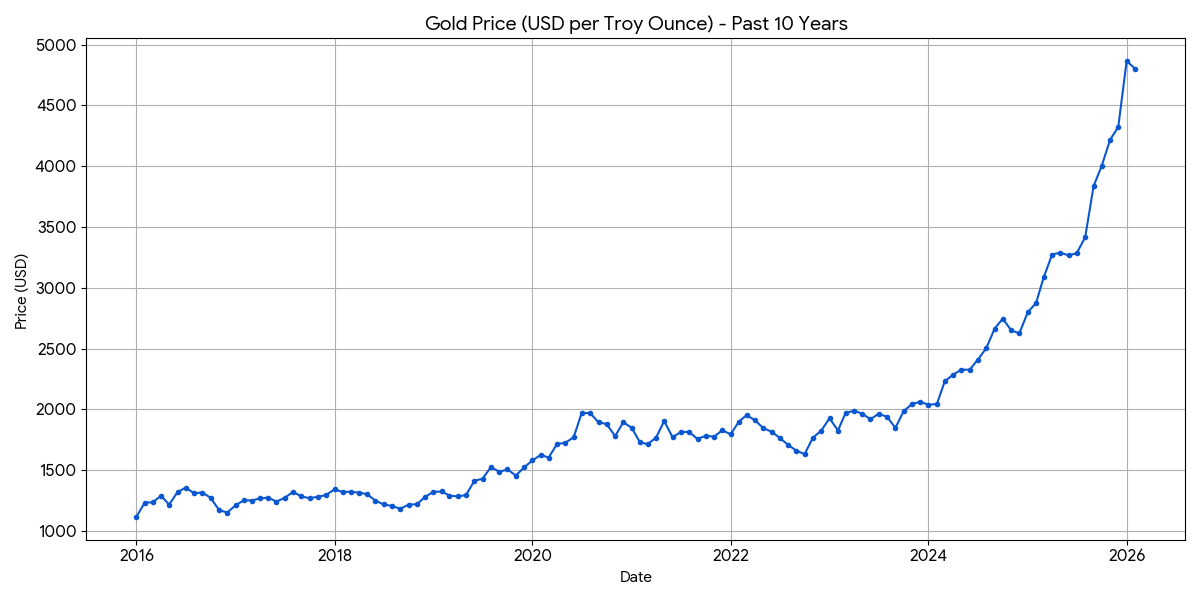
If you had ignored the noise and bought gold in those dark days of 2016, you would currently be sitting on gains that have outperformed nearly every major bond fund and many tech darlings. From that $1,050 low to the recent 2026 highs near $4,800, the 10-year chart tells a singular, undeniable story: the death of the “Zero Interest Rate Policy” (ZIRP) era and the violent return of tangible assets.
This article dissects the last decade of price action—not to dwell on the past, but to understand the future. The 10-year chart reveals a clear technical transition from a massive, coiled consolidation phase (2016–2023) to the violent repricing phase we are living through right now.

Gold Price Chart Last 10 Years
Phase 1: The “Wall of Worry” Recovery (2016–2019)
The first chapter of this decade began in the wreckage of December 2015, when gold touched a cyclical low of $1,046. Sentiment was abysmal. The Federal Reserve, under Janet Yellen, had just embarked on its first rate-hiking cycle in nearly a decade, a move that theoretically should have crushed gold prices further.
Instead, the market did something unexpected: it bottomed.
The Struggle for Direction
From 2016 through 2018, gold climbed a “wall of worry.” It was a frustrating period for investors. Every time the price rallied toward $1,375, it was slammed back down by hawkish Fed rhetoric.
-
The Headwind: The Fed raised rates nine times during this period, strengthening the U.S. Dollar.
-
The Resilience: Despite these hikes, gold refused to break new lows. It spent three years carving out a massive “base”—a technical floor that would eventually support the skyscraper we see today.
The Pivot Point: The 2019 Repo Crisis
The pivotal moment for the entire decade occurred not during the pandemic, but in the autumn of 2019. This was the “match that lit the fuse.”
In September 2019, the overnight “Repo Market” (the plumbing of the financial system where banks lend to each other) suddenly seized up. Rates spiked to 10% overnight, signaling that the banking system was running out of liquidity.
Fed Chair Jerome Powell was forced to make a U-turn. He pivoted from “Quantitative Tightening” (selling assets) to “Not-QE” (buying Treasury bills to inject cash).
-
The Signal: Smart money realized the Fed could never truly normalize rates without breaking the banking system.
-
The Breakout: Gold sniffed out this devaluation immediately. In mid-2019, it finally smashed through the $1,375 ceiling that had capped it for six years, surging to $1,500 by year-end.
Key Takeaway: The bull market didn’t start with COVID-19. It started when the bond market broke in 2019, proving that Central Banks would always choose inflation over insolvency.
Phase 2: The Pandemic & The “Triple Top” (2020–2023)
As the calendar turned to 2020, the slow grind of the recovery phase was abruptly ended by a black swan event that changed the global economy forever: COVID-19.
The 2020 Shock and Awe
When the world locked down in March 2020, gold initially crashed alongside stocks—a classic liquidity crisis where investors sold everything to raise cash. But unlike equities, gold rebounded almost instantly.
Fueled by unprecedented fiscal stimulus (stimulus checks) and monetary expansion (the Fed doubling its balance sheet in months), gold went parabolic. By August 2020, it shattered its 2011 record, hitting a new All-Time High of $2,075 per ounce.
But for the next three years, that specific number—$2,075—became a cursed ceiling.
The “Triple Top” of Frustration
For technical analysts, the chart from 2020 to 2023 is defined by the “Triple Top”—a massive wall of resistance that gold tried and failed to break three distinct times:
-
August 2020: The initial pandemic peak.
-
March 2022: As Russian tanks rolled into Ukraine, gold surged back to $2,070, only to be rejected as the dollar strengthened.
-
May 2023: During the collapse of Silicon Valley Bank and First Republic, gold rushed to safety at $2,075, but was again beaten back by the Federal Reserve’s “Higher for Longer” interest rate rhetoric.
During this period, mainstream financial media mocked gold investors. Inflation was raging at 9% (CPI), yet gold was trading sideways. What they failed to see was that gold was building massive potential energy. It was carving out the “handle” of a gigantic, multi-decade “Cup and Handle” formation—one of the most bullish patterns in technical analysis.
The market was coiling. It was waiting for a trigger that would prove the Federal Reserve had lost control.
Phase 3: The Breakout & The Super-Spike (2024–2025)
The coiled spring finally snapped in early 2024. This marked the end of the consolidation and the beginning of the “Repricing Phase”—a period where the market realized that U.S. debt was mathematically unsustainable.
The 2024 Catalyst: The Silent Pivot
While the Fed talked tough about interest rates, the bond market began to revolt. The U.S. interest expense on its debt crossed $1 trillion annually. Global central banks, led by China, Poland, and Singapore, stopped buying U.S. Treasuries and started buying gold at a record pace.
This “hidden hand” of sovereign buying put a permanent floor under the price.
-
The Breakout: In March 2024, gold finally smashed through the $2,075 resistance with conviction. Unlike previous attempts, it didn’t look back.
-
The Psychology Shift: Western investors, who had largely ignored gold for tech stocks, began to chase the momentum.
The 2025 Explosion
If 2024 was the year of the breakout, 2025 was the year of the “Super-Spike.” As outlined in our 2025 Annual Review, the metal went on a historic run, driven by a perfect storm of geopolitical fragmentation and a loss of faith in fiat currencies.
-
The Numbers: Gold opened 2025 near $2,600 and closed the year near historic highs, registering a stunning ~64% annual gain.
-
The Driver: It wasn’t just fear; it was debasement. With the U.S. deficit running unchecked and the BRICS+ nations launching gold-backed trade settlement mechanisms, gold was re-monetized on the global stage.
The “Triple Top” that had capped prices for three years acted like a dam. Once it broke, the floodwaters of capital unleashed a vertical move that stunned even the most ardent gold bugs. We watched gold slice through $3,000, then $4,000, finally finding air near the current levels.
Technical Note: The “Cup and Handle” pattern projected a measured move to roughly $3,000. The fact that we overshot this target so dramatically in 2025 suggests we are in a “blow-off top” scenario or a fundamental paradigm shift akin to the 1970s.
Analyzing the Macro Drivers: The “Broken Correlation”
When future historians look back at the gold chart of 2024–2026, they will notice a fascinating anomaly that baffled traditional economists at the time: Gold rose while interest rates remained high.
For decades, the “textbook” rule was simple:
-
High Real Rates = Low Gold Prices (Because bonds pay a yield and gold does not).
-
Low Real Rates = High Gold Prices.
However, in the last two years of this decade-long chart, that correlation completely broke down. Why?
1. The Fiscal Dominance Epiphany
The market collectively realized that the Federal Reserve is no longer in charge; the U.S. Treasury is. With U.S. debt crossing $40 trillion, raising interest rates to fight inflation simply causes the government’s interest bill to explode, requiring more money printing to pay the bondholders.
Investors bought gold in 2025 not because they feared low rates, but because they feared the Debt Spiral. They realized that in a regime of “Fiscal Dominance,” the currency must be debased regardless of what the interest rate is.
2. Weaponization & De-Dollarization
The 10-year chart also tracks the geopolitical decline of the U.S. Dollar. Following the sanctions on Russia in 2022 (where FX reserves were frozen), global central banks realized that U.S. Treasuries were no longer a “risk-free” asset—they were a political tool.
-
The Shift: China, Turkey, India, and Poland aggressively swapped dollars for gold bars.
-
The Impact: This sovereign buying created a price floor that speculators couldn’t short through. The “Western” price of gold (determined by London and New York) was overtaken by the “Eastern” bid (determined by Shanghai and Mumbai).
Future Projections: The Next 10 Years (2026–2036)
If the last 10 years were about “The Recovery,” the next 10 years will likely be defined by “The Reset.”
Technical analysis of the 10-year chart suggests that the move to $4,800 is not the finale. Using Fibonacci extensions derived from the 2011–2015 bear market and the 2016–2023 consolidation, long-term targets point significantly higher.
Technical Targets
-
The $5,500 Level: This represents the 2.618 Fibonacci extension of the 10-year base. It is the next major psychological battleground.
-
The “Shadow Gold Price”: Some analysts argue that for gold to fully back the expansion of the global monetary base (M2) that occurred since 2020, the price would need to reset closer to $10,000–$15,000 per ounce by the early 2030s.
The Role of CBDCs
The fundamental driver for the next decade will likely be the introduction of Central Bank Digital Currencies (CBDCs). As governments move toward programmable, trackable money, gold will increasingly be valued not just as an inflation hedge, but as a privacy hedge. It will remain the only tier-1 asset that is outside the digital control grid, a feature that will command an ever-increasing premium.
Conclusion: The “Middle Innings” of the Bull Market
Looking at the 10-year chart from 2016 to 2026 is a lesson in patience and perspective.
-
We endured the “boring years” (2016–2018).
-
We survived the “frustrating years” (2020–2023).
-
We are now enjoying the “reward years” (2024–Present).
But make no mistake: a 10-year base usually supports a multi-decade trend. The breakout from the massive “Cup and Handle” pattern that resolved in 2024 is technically projected to last for years, not months.
While corrections are inevitable—and healthy—the macro conditions that created this chart (debt, debasement, and geopolitical fracture) are not improving; they are accelerating.
If you are looking at the chart today and wondering if you “missed the boat,” remember the lesson of 2016. The best time to buy was yesterday. The second best time is today.
Actionable Next Steps
-
Zoom Out: Don’t check the price daily. Review the weekly and monthly charts to filter out the noise.
-
Check Your Allocation: Does gold represent 5-10% of your net worth? If the bull market continues as projected, being underweight is a significant risk.
-
Secure Your Gains: If you have been holding since 2016 or 2019, consider taking some profit off the table to rebalance into lagging assets (like silver or high-quality miners) while maintaining your core “insurance” position.


